
In 2026, competition among eCommerce businesses will not be fought solely on price and assortment. What will truly make the difference is the ability to deliver orders and manage returns in a more efficient, flexible, and customer-centric way—without further eroding margins.
The good news is that many of the optimizations that are decisive for eCommerce today do not require technological revolutions or multi-year projects. Instead, they rely on quick operational decisions based on concrete data and already available levers that directly impact costs, conversion rates, and service quality.
In an increasingly mature and competitive market, waiting means accumulating inefficiencies. In this article, you will find three strategic and immediately actionable steps designed for successful eCommerce businesses that want to face 2026 at their best by acting today on what truly matters.
1. Rethink Your Last-Mile Logistics
Last-mile logistics has become the most frequent breaking point in the eCommerce experience. This is where delays, failed delivery attempts, extra costs, and customer service requests tend to concentrate. Most importantly, it is the moment when the end customer truly experiences the brand’s level of service—regardless of how efficient the marketing may be.
Why Last-Mile Logistics Is Now eCommerce’s Main Efficiency Constraint
Two data points are enough to frame the issue from an operational perspective.
The first concerns expectations: in Europe, if a customer’s preferred delivery option is not available at checkout, cart abandonment increases dramatically. According to recent data collected by DHL, 81% of shoppers abandon their cart if their preferred delivery option is not available at checkout (and 79% if their preferred return method is not offered).
The second data point relates to changing habits: again according to DHL data, 35% of Europeans already receive deliveries via Out of Home solutions. For returns, the preference is even stronger: 79% of Europeans return products through parcel lockers or parcel shops.
Translated into optimization terms, Out of Home is no longer an “extra.” It is a structural lever to increase control over the delivery experience and reduce the typical inefficiencies of home delivery.
Pickup Points and Lockers: From Alternative Option to Operational Standard
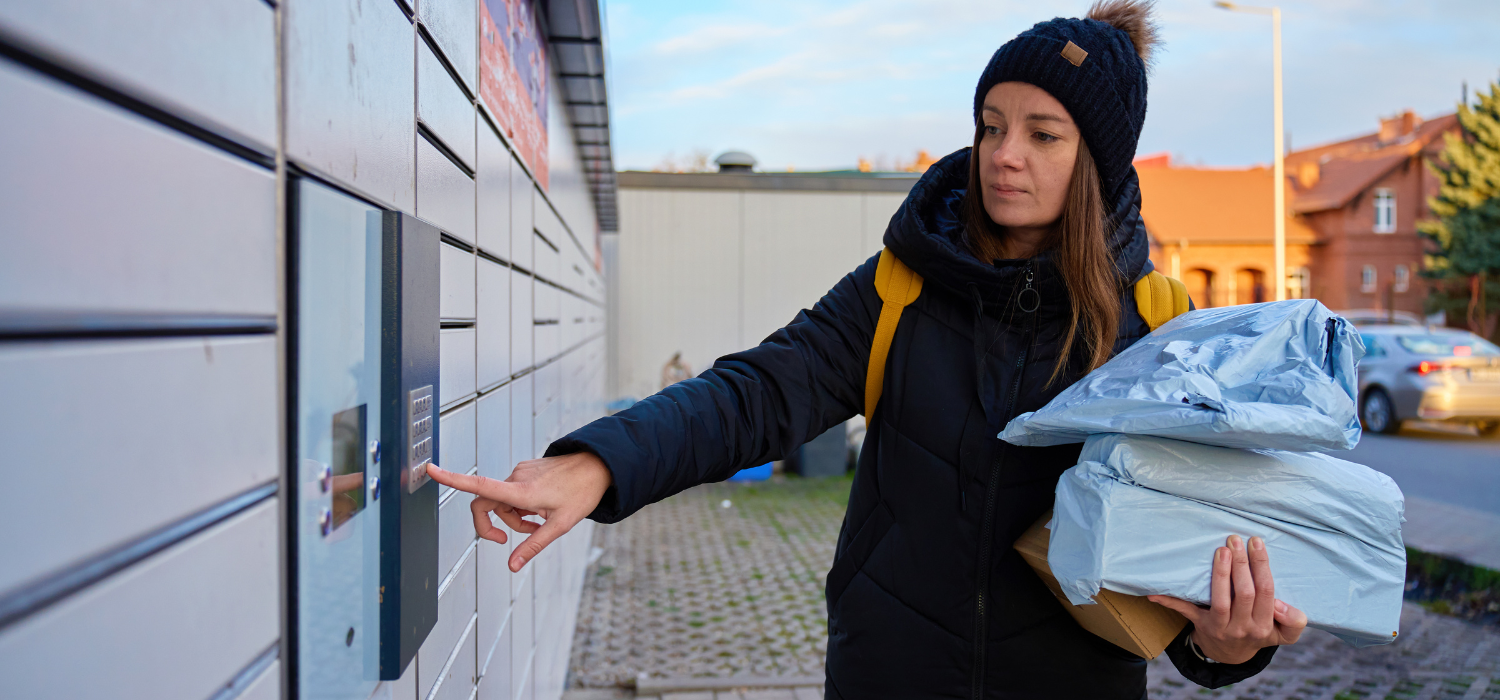
When a customer chooses a Pickup Point or Locker, the critical moment of delivery shifts from an unpredictable context—dependent on the customer’s schedule and home presence—to a standardized and trackable environment.
In other words, for merchants this means fewer support requests and complaints, while for carriers it means higher delivery density and route stability.
For an eCommerce business, the point is not simply to add another delivery option at checkout. Real optimization comes from treating Out of Home as a structural delivery method, integrated into the last-mile strategy, with measurable effects on conversion rate, operational costs, and customer experience quality.
How to Integrate Out of Home Services into eCommerce and Logistics Flows
The difference is not theoretical—it is operational. Out of Home generates value only when it is integrated into eCommerce and logistics processes, from how it is presented at checkout to how it is managed in transport and warehouse systems, all the way to delivery and return event tracking.
Here are some practical recommendations.
Checkout: Make Out of Home a Clear and Immediate Choice
At the most sensitive touchpoint in the funnel—the checkout—Out of Home delivery options, such as Lockers and Pickup Points, must be presented clearly and understandably, so they are perceived as a convenient and natural choice rather than a “secondary” alternative to home delivery. The best approach is to offer options based on proximity and availability, making the choice immediately practical.
Logistics Orchestration: Treat OOH as a Standard Delivery Mode
Integration cannot stop at the user experience. Operationally, Out of Home must be managed as a true delivery mode within logistics systems, with dedicated flows in TMS and WMS platforms, tracked events, and consistent exception management. Only then can real benefits be achieved in terms of efficiency and last-mile stability.
Returns: Close the Loop with Integrated OOH Flows
The value of Out of Home is fully expressed when it includes the reverse flow. Enabling returns through Lockers and Pickup Points simplifies the customer experience and, at the same time, standardizes a process that is often fragmented and costly. OOH thus becomes a control point not only for delivery but also for goods re-entry.
Within this scenario, the value of GEL Proximity stands out: a leading technology in Out of Home services with over 500,000 Pickup Points and Lockers for eCommerce deliveries and returns, designed to integrate with online stores and logistics systems, making OOH a concrete and scalable lever.
2. Optimize Returns: From Inevitable Cost to Competitive Lever
In 2026, competitive advantage will not come from promising “free returns for everyone,” but from the ability to manage returns as an industrial process—fast, trackable, low-friction for customers, and cost-controlled for operators.
The Real Returns Challenge in 2026
Returns are a massive and measurable issue. According to data from the National Retail Federation and Happy Returns, retail returns in the United States reached $890 billion in 2024, and retailers estimate that on average 16.9% of sales are returned.
Although these figures refer to the U.S. market, the message is universal: returns are an operationally intensive flow. They increase customer care contacts, complicate warehouse planning, generate peaks, and put pressure on transport and reverse logistics.
In addition, the NRF highlights rising customer expectations: 76% of eShoppers consider free returns a key factor when choosing a retailer, while 67% say they will not return to an online store after a negative return experience.
Pickup Points as a Strategic Hub for eCommerce Returns
The most common mistake is to consider returns as simply “shipping in reverse.” In reality, they are both a customer experience and a logistics flow that must be designed.
In eCommerce returns, Out of Home can act as an accelerator because it reduces dependence on home pick-up (which is costly and complex to plan), increases accessibility (customers can return items whenever they want, near home or work), and standardizes the return entry point (making it easier to track and consolidate).
How to Structure an Efficient OOH Returns System
In practice, a well-designed Out of Home return is not the result of a single choice, but of three operational decisions that directly affect customer experience and logistics efficiency.
Reduce Friction
Labels to print at home, unclear instructions, specific packaging requirements, and complex procedures increase the likelihood that customers postpone or even abandon the return. The result is more customer service contacts and a decline in perceived service quality. For this reason, paperless solutions—such as QR codes at Lockers and Pickup Points, or including a pre-printed return label inside the parcel—are becoming an increasingly required operational standard.
Ensure End-to-End Visibility from the First Drop-Off Point
An efficient returns system cannot afford blind spots. When a customer drops off a parcel at a Locker or Pickup Point, that return must immediately become visible in the eCommerce systems. This early visibility allows real-time order status updates, faster refunds or replacements, and reduced post-purchase uncertainty. In other words, control over returns does not begin when the parcel arrives at the warehouse, but at the very moment it enters the Out of Home network.
Integrate Technology and Network to Make Returns Truly Scalable
The quality of the return experience also depends on the supporting infrastructure. A limited or fragmented Pickup Point network reduces convenience for customers and complicates operations. On the contrary, a widespread network supported by smooth technological integration allows flows to be standardized and reverse logistics to be simplified. When technology and network work together, returns stop being exceptions managed case by case and become a structured, predictable, and sustainable service—even at high volumes.
3. Make Checkout the Strength of Your eCommerce
According to data from the Baymard Institute, which has systematically analyzed user behavior during online purchases for years, the global average cart abandonment rate is 70.19%. This highlights that the issue is not product interest, but the ability to guide users all the way to conversion.
In most cases, abandonment is caused by friction that emerges precisely at checkout. Every obstacle translates into lost margin, and a significant portion of these frictions does not depend on layout or interface design, but on what is offered at that moment—available delivery options, timing, costs, and return policies.
Use Delivery Choice as a Conversion Driver
As highlighted at the beginning of this article, if the absence of a preferred delivery method at checkout can push a large share of users to abandon their purchase, then the most concrete optimization is to provide real choice where it matters most—at checkout.
It is not enough to simply add another carrier. What is needed is to offer:
- home delivery, for those who want it;
- Out of Home delivery via Lockers and Pickup Points, for those seeking control and flexibility;
- clear return options already during the purchase phase.
Which KPIs to Consider to Improve eCommerce Checkout Performance
In practical terms, checkout can be viewed as a true performance lever. This is where technology choices related to delivery translate into measurable results across three key KPIs.
Conversion Rate
When customers find truly relevant delivery options—rather than limited or inflexible choices—the likelihood of abandonment decreases. Offering credible alternatives, such as Out of Home delivery alongside home delivery, reduces drop-offs caused by insufficient options.
Cost to Serve
A higher share of consolidated deliveries and fewer operational exceptions translate into fewer hidden costs, fewer customer service requests, fewer re-delivery attempts, and less manual complaint handling. In this sense, delivery technology becomes a tool for operational efficiency.
Retention
A simple, predictable, and frictionless delivery and return experience directly affects customers’ likelihood to come back. Over time, the quality of post-purchase service is often remembered more than the product itself.
In this scenario, integrating an extensive and interoperable Out of Home network such as the one enabled by GEL Proximity is an immediately actionable step. It does not require redesigning the entire supply chain, but rather optimizing choice points at checkout and industrializing delivery and return flows through a solid technological layer that is already ready to scale.
Want to understand how to immediately integrate Pickup Points and Lockers into your eCommerce or logistics systems, enabling large-scale Out of Home deliveries and returns? Contact us now and find out how.