
The false myth: lockers as a universal solution
In recent years, parcel lockers have been portrayed as the answer to last-mile complexity. The promise is simple: automated delivery, 24/7 access, flexibility for consumers, fewer failed delivery attempts, improved efficiency, and lower operating costs.
This narrative has worked—lockers have grown rapidly across Europe, but it has also created a misconception: installing lockers does not automatically mean building an effective network.
In urban logistics, universal solutions rarely exist, and installing lockers does not equate to solving all last-mile challenges.
The point is not to question the role of lockers, which are and remain a fundamental component of Out-of-Home delivery, but to move beyond the idea that they can work on their own. The real challenge today is designing proximity networks capable of integrating different solutions, adapting to local contexts, and capturing real user behaviors.
In this article, we explain why the “one-size-fits-all” model does not work in the last mile and what the key elements are for designing a truly effective Out-of-Home network—from the combination of lockers and PUDO, to the decisive role of location and density.
What the market (and the data) really says
There is no single solution
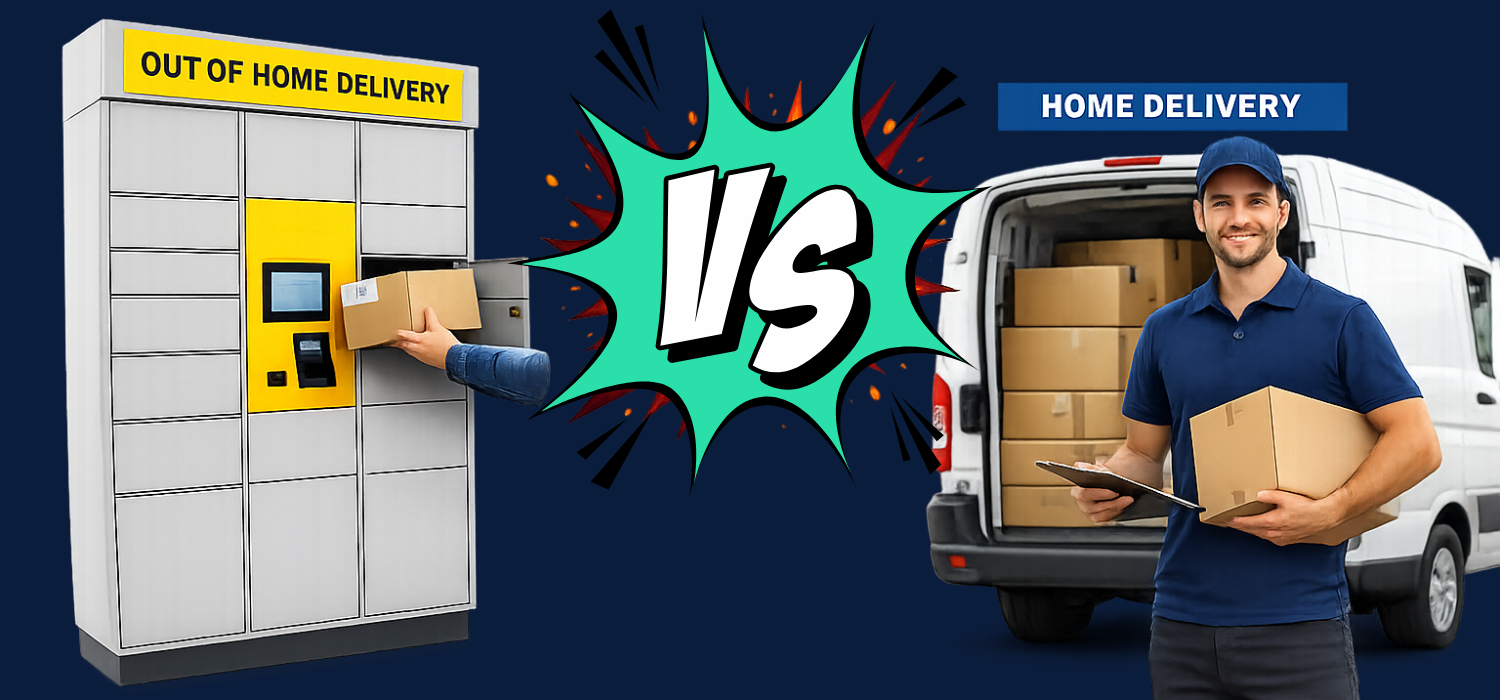
Challenging this perspective is, among others, The Ultimate Out-of-Home Delivery Handbook 2026 by Last Mile Experts, a leading authority in the sector. The report highlights how the most effective models are not based on a single asset, but on integrated networks that combine lockers and PUDO (Pick-Up/Drop-Off points).
The reason is simple: the performance of Out-of-Home deliveries depends on the utilization level of the points, not merely on their presence in a given area.
A locker does not create value simply by existing—it creates value when it is used, and its usage depends on factors far more complex than installation alone.
The same report also emphasizes the decisive role of network density and location, showing how inefficient distribution leads to insufficient volumes and, consequently, suboptimal costs.
In other words, the issue is not the locker itself, but the context in which it is placed.
Why “one-size-fits-all” doesn’t work in the last mile
At the core of the myth of lockers as a universal solution lies the assumption that consumer behavior is uniform and predictable—the so-called “one-size-fits-all” approach. But reality is quite the opposite.
Delivery habits vary significantly between dense urban areas and suburban contexts, as well as across different user segments. In some cities, for example, Out-of-Home delivery is already the dominant choice; in others, it still complements home delivery.
This is precisely the point emphasized by the Last Mile Experts report: demand is not homogeneous and strongly depends on geographic context and local behaviors.
There is also another crucial—and often underestimated—factor: proximity.
One of the key concepts is “on-my-way.” Users are willing to use Out-of-Home pickup points only if they are located along their daily routes. When a detour is required, adoption drops rapidly.
So, it is not the technology itself that determines the success of Out-of-Home delivery, but how well it is integrated into people’s real-life flows. In other words, success does not belong to those with the most lockers, but to those who are closest to the consumer.
The real answer: designing a network, not installing assets
If the limitations of the “one-size-fits-all” model are clear, the direction of the industry’s evolution becomes equally evident. The most effective Out-of-Home networks are based on a combination of solutions. Automated lockers, partner stores, and hybrid points work together to cover different needs and adapt to diverse contexts.
This complementarity is not a minor operational detail—it is the core of the model. It enables higher density, better accessibility, and the ability to capture real demand.
Within this framework, the true critical factor becomes network design.
As highlighted by Last Mile Experts, location strategy – also discussed in our in-depth analysis – is crucial to the success of Out-of-Home delivery and must take into account multiple variables such as foot traffic, accessibility, and integration into consumers’ daily routes.
It is therefore not (only) about adding more points, but about building an effective distribution network. Today, the difference is not made by those who invest the most in infrastructure, but by those who know where to place it.
From technology to strategy
Parcel lockers undoubtedly remain a fundamental component in the evolution of the last mile—it would be a mistake to underestimate their role—but it is equally risky to consider them a self-sufficient solution. Without a network strategy, even the most advanced technology risks being underutilized.
Today, the real lever is no longer the single asset, but the ability to connect it with others. In this context, orchestration becomes a key enabler: it allows the integration of lockers, PUDO points, and operator networks into a coherent system, reducing fragmentation and making the network more flexible, adaptive, and aligned with real user behavior.
It is not just about having more points, but about making them work together in the right way—enhancing each node and maximizing its utilization. And in a context where efficiency and margins are increasingly under pressure, failing to do so is no longer sustainable.
The future of the last mile is not made of individual assets, but of ecosystems where different solutions coexist and complement each other. Lockers, pickup points, operator networks: value comes from their integration, not from choosing one over the other.
Platforms like GEL Proximity are designed precisely with this goal in mind: to unify different networks, enable multiple solutions simultaneously, and let context—and the consumer—determine the best option based on specific needs.
Through a single integration, GEL Proximity gives you access to a network of over 500,000 pickup points and lockers, simplifying delivery management and expanding the options available to retailers and logistics operators. Our orchestration software makes it possible to overcome the typical fragmentation of the last mile by coordinating multiple networks and operators within a single technological layer, enabling dynamic delivery management that adapts to volumes, geographic areas, and user behavior.
In other words, it is not just about expanding access to points, but about managing their use intelligently—maximizing efficiency and network coverage.
Learn more about our services or contact us for a personalized demo!