
The Italian delivery market continues to expand. Data from the AGCOM Communications Observatory for 2024 confirms that the postal services sector is still growing, driven decisively by the parcel segment. Last year, revenues from parcel delivery services reached €6.83 billion, up from €6.70 billion in 2023. This growth significantly impacts the entire postal sector, which increased overall by €163 million.
But what do these numbers actually tell us? Looking at the data, it’s clear that despite a complex economic context, Italian eCommerce continues to generate substantial logistics flows and a structural increase in demand for delivery services.
To fully understand this dynamic, we must look at the relationship between revenue growth in parcel delivery services and the evolution of eCommerce. In 2025, the sector surpassed the symbolic threshold of one billion parcels per year, with over 94,000 active digital stores (as discussed in our article dedicated to the Italian last-mile market). This boom has required logistics operators, couriers, and retailers to reposition themselves both technologically and operationally.
The new AGCOM report adds a macroeconomic lens to the analysis: parcel revenue growth is not episodic but structural, capturing a market that is changing in its composition, competitive dynamics, and infrastructural needs.
In this article, we will examine these elements by focusing on the key data points presented in AGCOM’s Communications Observatory and on why this evidence reinforces the central role of Out-of-Home solutions for the future of the Italian last mile.
AGCOM’s Numbers: How the Italian Parcel Market Changed in 2024
According to AGCOM’s Communications Observatory, postal service revenues reached €8.59 billion in 2024, of which €6.83 billion is attributable to the parcel segment. More specifically, parcel revenues increased by €123 million year over year.
This is the most dynamic component of the postal sector, while correspondence service revenues remained essentially flat, with only a marginal €40 million increase.
This confirms a consolidated trend: eCommerce logistics is the true engine of growth in the Italian postal market.
The continuous rise in online purchases, combined with the growing preference for fast and flexible delivery services, is reshaping operator priorities and making a rethinking of delivery models unavoidable.
Domestic vs Cross-Border Services: What’s Really Happening?
Looking at the balance between domestic and cross-border services, domestic services grew by 3.7%, reaching €6.39 billion, while cross-border services declined slightly (–2.8%), totalling just over €2 billion.
This figure is strategically important because it demonstrates that the most dynamic demand is domestic, not international. In other words, logistics pressure is concentrated mainly in Italian urban areas, where the traditional delivery model is increasingly showing its limits.
More Volume, More Complexity, More Costs
However, revenue growth in parcel delivery alone doesn’t fully describe the context. The AGCOM report highlights an increase in 12-month cumulative volumes for both domestic and international parcels. Meanwhile, correspondence volumes are dropping significantly, increasing the dependence of logistics networks on the eCommerce segment.
This triggers a domino effect: more volume, greater operational complexity, rising costs, and a delivery model struggling to remain sustainable.
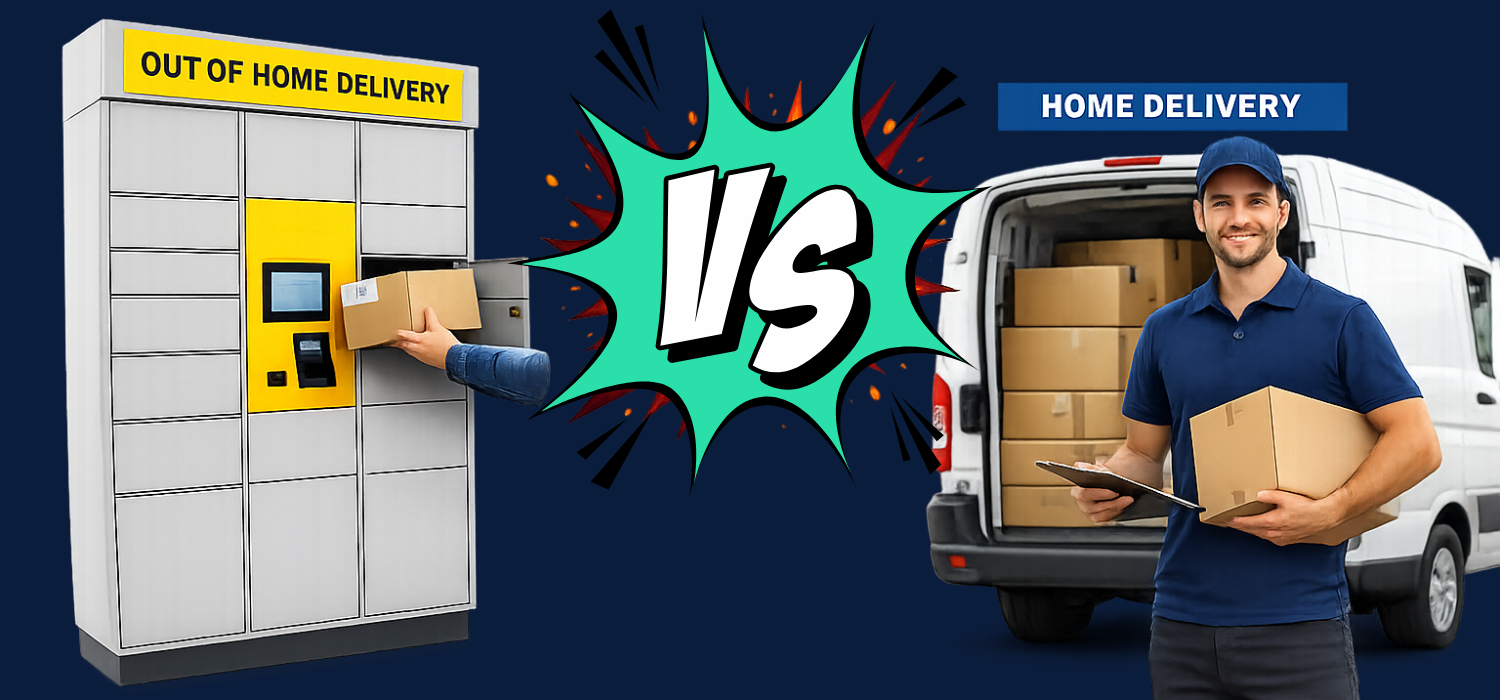
The Last-Mile Effect: The Door-to-Door Model Shows Its Limits
The home delivery model is particularly strained by rising volumes, and AGCOM data on unit revenues and market shifts captures this very phenomenon. Rising labour costs, fuel prices, travel times, and urban inefficiencies are not being offset by a proportional increase in revenues.
In other words, every parcel delivered costs couriers increasingly more, and part of these costs inevitably falls on eCommerce businesses in the form of higher shipping fees and growing difficulty in guaranteeing consistent service levels.
The Delivery Density Challenge: The Real Issue for Couriers and Retailers
At the heart of the problem is density. Fragmented deliveries scattered across congested urban areas with increasingly tight time windows drastically reduce delivery efficiency.
This is where the structural limits of the home-delivery model clearly emerge, along with the resulting need for solutions that consolidate flows, increase driver productivity, and reduce failed delivery attempts.
Out-of-Home Delivery: The Turning Point for the Parcel Market
As AGCOM data shows, volumes are stabilizing at increasingly high levels. The bigger picture is that the market has moved beyond the post-pandemic emergency phase and is entering a maturity stage where efficiency becomes the key competitive factor.
Efficiency that can be ensured through more sustainable delivery methods—economically and environmentally—specifically Out-of-Home delivery.
The shift concerns not only online shopping: the Italian logistics system is undergoing a broader transformation driven by the need for denser, more integrated, and more technologically advanced delivery networks.
Lockers and Pickup Points are therefore becoming part of this process, taking their place in the urban delivery infrastructure alongside transport networks and local fulfillment hubs.
Why the Parcel Market Is Accelerating Toward Out-of-Home Delivery
AGCOM data and broader industry analyses point clearly in one direction: Out-of-Home delivery is no longer an option but the structural response to the new needs of the market.
Lockers and PUDOs are the only effective answer to the growing need for efficiency, enabling couriers to increase delivery density while reducing routes, operational costs, and failed attempts.
For eCommerce businesses, they represent a sustainable and scalable alternative capable of improving customer experience without raising shipping fees.
Sustainability and Costs: How OOH Helps Rebalance the Courier Business Model
Centralizing flows at shared delivery points also reduces emissions, travel times, and resource usage—both vehicles and personnel.
This provides a competitive advantage that directly impacts all sector KPIs, from PDD (Parcel Delivery Density) to driver productivity, all the way to latency reduction.
What Changes for Industry Players
The structural integration of Out-of-Home networks has significant implications for both online merchants and logistics operators.
For eCommerce retailers, integrating OOH points into the checkout process means greater efficiency, lower costs, and improved sustainability, since it reduces delivery expenses, increases available options, and optimizes return flows.
The benefits extend to physical retailers as well: by becoming Pickup Points, they turn into commercial touchpoints capable of generating additional foot traffic and new sales opportunities.
For couriers, Lockers and PUDOs translate into higher productivity in last-mile flows, thanks to the ability to deliver dozens of parcels at a single point—improving margins in an increasingly competitive market.
GEL Proximity’s Role in a Rapidly Transforming Parcel Market
GEL Proximity provides the largest European network of PUDO and Locker points — over 500,000 locations already active across Europe — accessible through a single integration.
The APIs make it possible to rapidly activate a dense network of delivery and return points, improving operational efficiency and service flexibility.
Density, productivity, punctuality, cost reduction: OOH has a direct impact on all indicators that define competitiveness in the sector today.
With a market that continues to grow while demanding ever more efficiency and sustainability, the only viable way to stay competitive is to embrace Out-of-Home delivery, which will soon become the standard solution for deliveries and returns.
Want to integrate PUDOs and Lockers into your online store or logistics network? Contact us and discover what GEL Proximity can do for you.