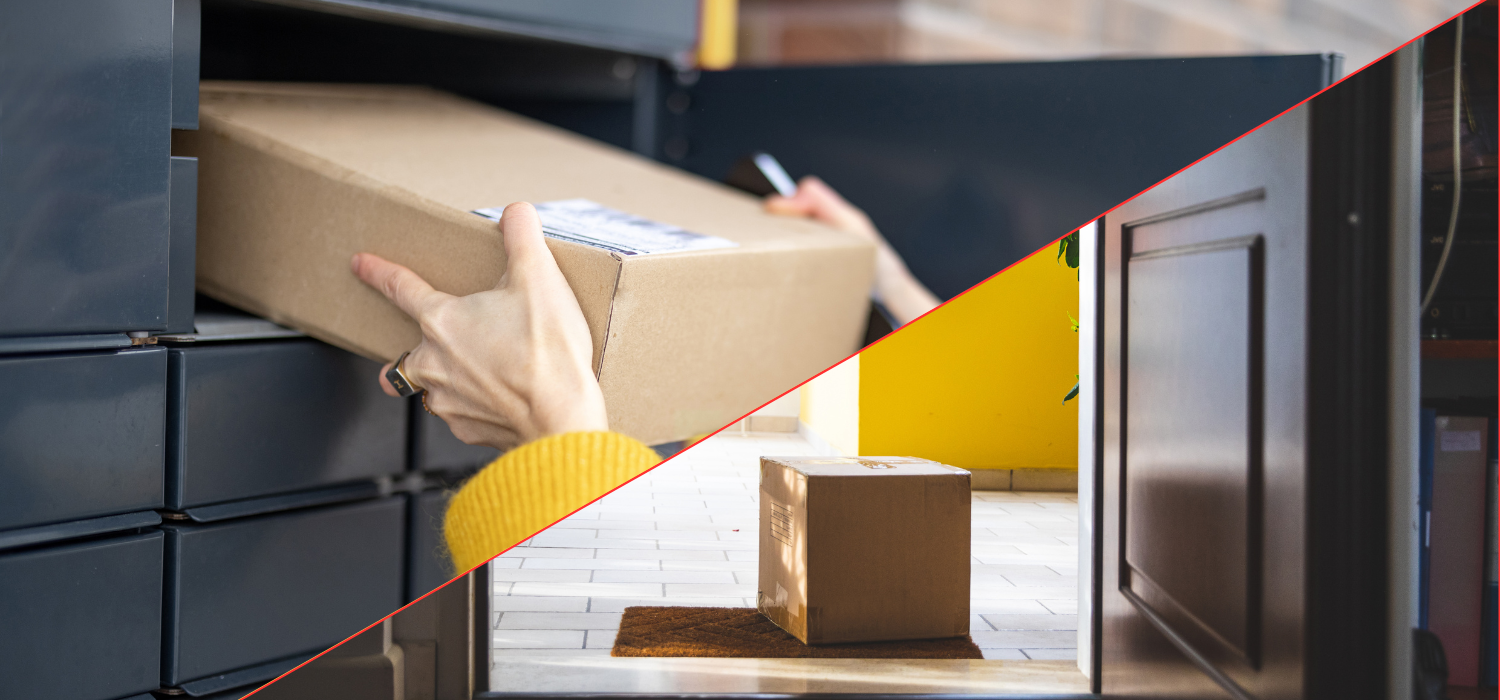

In 2022, B2c eCommerce shipments in Italy reached 565 million with a 2% growth over the previous year. A trend with a positive sign that since Pandemic has never stopped, although it has slowed down – predictably – compared to the 2020 boom when growth had been 43% for a total of 481 million shipments.
Logistics as a marketing lever for eCommerce
Taking a look at the numbers, it is therefore easy to see the strategic role played by logistics for eCommerce success. Indeed, quality of service, speed and price are key factors for eShoppers who are faced with thousands of online stores and a vast supply. All things being equal, therefore, the difference is made by the shipping (and return) service, which becomes a marketing lever.
But there is an additional proportionality to take into account: as the number of deliveries increases, so does the impact they have on the environment and, consequently, the need to find more sustainable delivery solutions. Indeed, we cannot forget that last-mile logistics is the most polluting part of the entire logistics process. Freight traffic is estimated to contribute between 20 and 30 percent of air pollution in urban areas, and last mile delivery vehicles account for nearly one-third of total traffic in cities.
OOH services grow
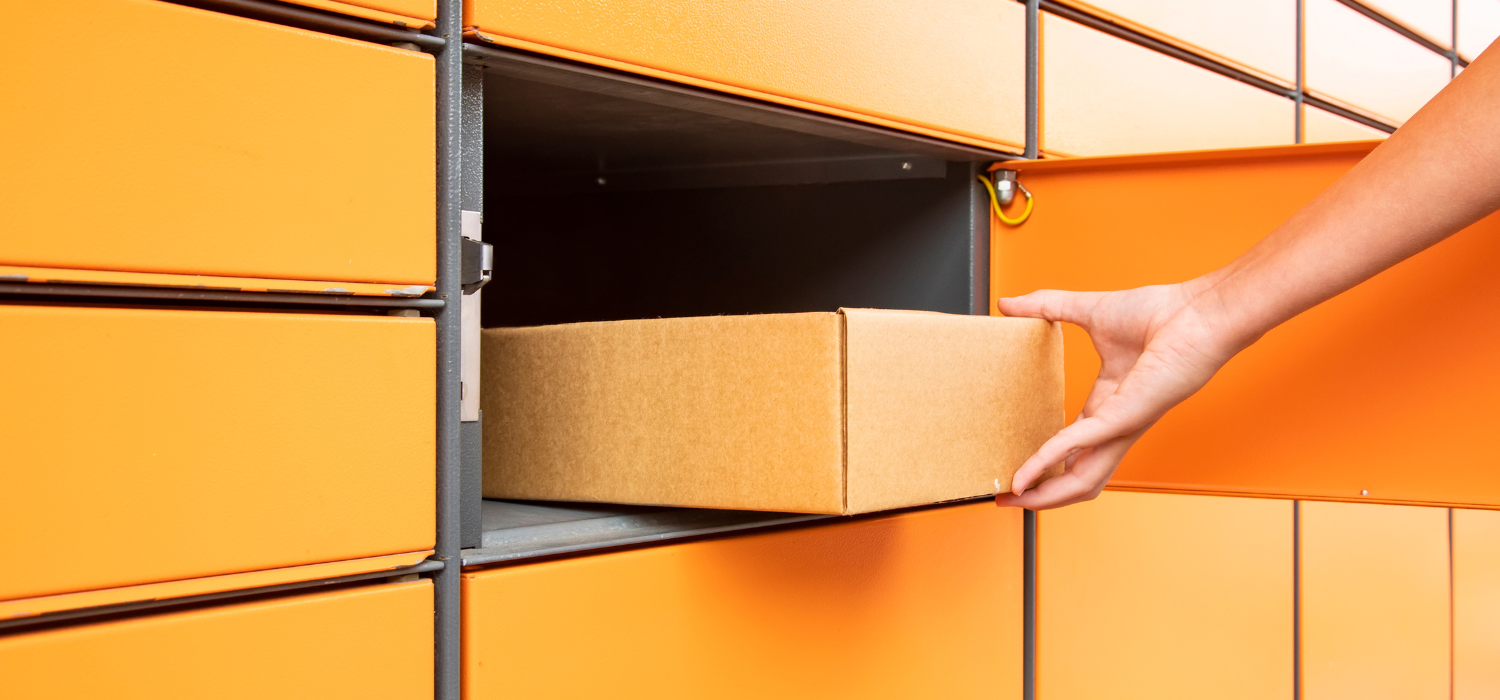
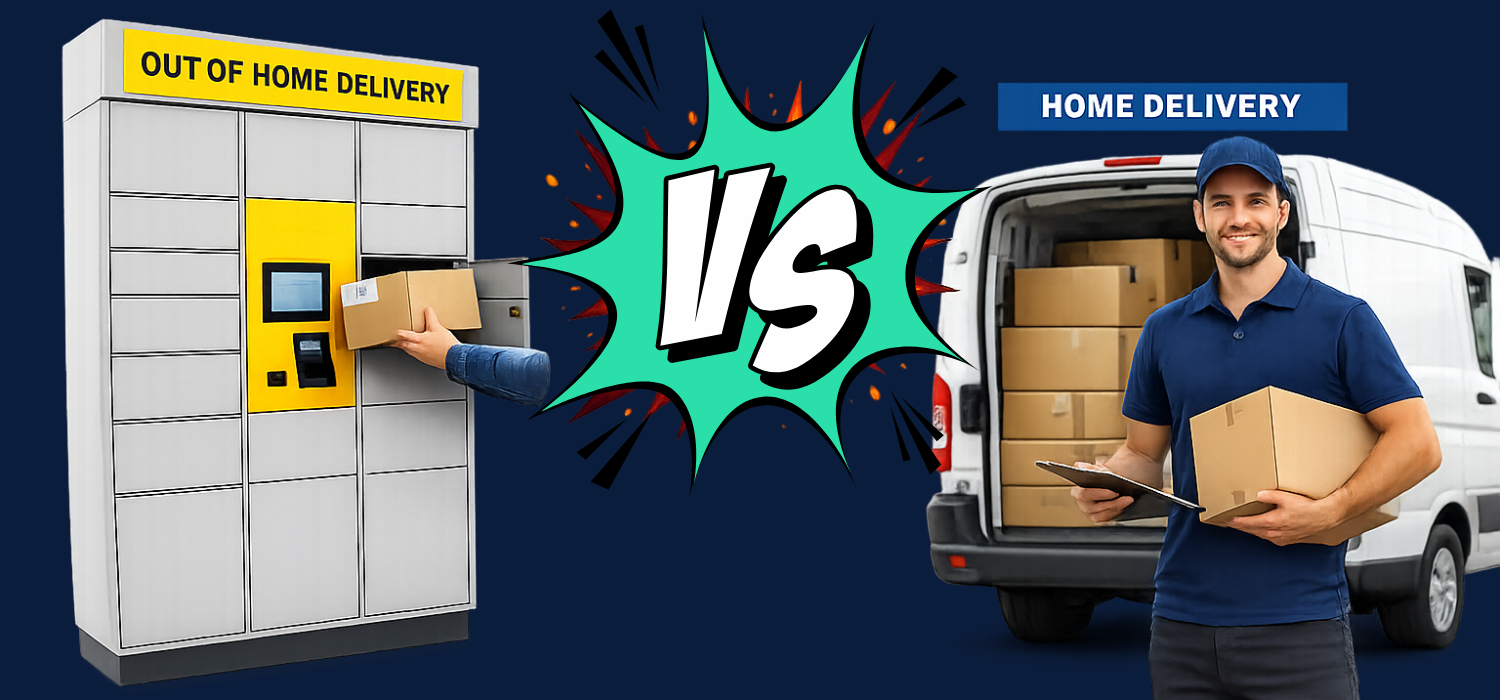
Good news, however, comes from the Out Of Home front; that is, all those alternative services to traditional Home Delivery that allow consumers to pick up their online purchases outside the home.
According to data provided by the eCommerce B2c Observatory of the Politecnico di Milano, in 2023 there will be about 60 thousand, including Parcel Locker and PUDO (post offices, newsstands, etc.), pickup points in Italy enabled to pick up online orders. That is, we are talking about 35 thousand more Points than in 2020 with a percentage change of 140%.
In addition, 65% of retailers have enabled in most of their stores the Click&Collect service, for a total of about 20 thousand points of sale where it is possible to pick up orders placed online.
Top delivery services offered by top merchants
Keyword: speed
The desire to be able to get a product purchased online in our hands quickly, let’s face it, concerns all of us. Here, then, is where speed of delivery is key. In fact, 72 percent of merchants already offer their consumers express delivery in just one or two business days. Waiting time that drops to 24 hours for 26 percent of merchants and to just one or two hours (in urban areas) in 20 percent of cases.
Keyword: location
The location where a package is picked up is also a key element, especially considering that it is not always possible to stay at home and wait for the courier to arrive. As a result, 68 percent of merchants offer alternative delivery options to traditional home delivery (a solution that is still offered in 98 percent of cases), including: 48 percent directly in-store, 32 percent at third-party Pick Up points, 32 percent at Parcel Locker and, finally, 8 percent at proprietary pick-up points.
Key word: added value
But that’s not all. Among the main trends related to deliveries we also find the possibility for consumers to schedule a delivery by appointment (a service offered by 52% of merchants); to receive a parcel on Saturdays (34% of cases) or in the evening (34%); or again, to have the parcel delivered to a neighbor or a safe location of their choice.
Yes, but how much does an Out Of Home delivery save, both in economic and environmental terms, compared to Home Delivery?
The figure was recently presented at Netcomm FOCUS Logistics and Packaging (at which we at GEL Proximity were also present) and comes directly from the Milan Polytechnic’s B2c eCommerce Observatory.
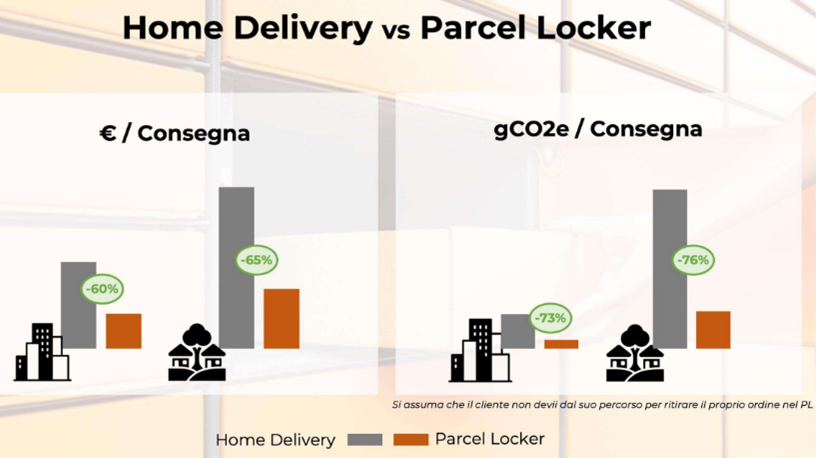
Home Delivery vs. Parcel Locker. Fonte: Osservatorio eCommece B2c Politecnico di Milano
Comparing Home Delivery and OOH in an urban context and in a more rural context it turns out in fact that thanks to Parcel Lockers it is possible to save in terms of euros per delivery up to 60 percent in the case of an urban context and up to 65 percent in the case of a more rural context. The most important and significant figure, however, comes from the savings in terms of CO2 emissions. Thanks to Parcel Lockers, it is in fact possible to save up to 73% in emissions in urban and up to 76% in extra-urban contexts, provided that the customer does not deviate from what is the route he would normally have traveled, without therefore having to make variations on his route.
Figures that, by the way, also outperform in terms of efficiency-both economic and environmental-even other alternative delivery modes involving, for example, the use of cargo bikes (-30% €/delivery ratio and – 55% gCo2e/delivery ratio) or Drones and Vans (+30% €/delivery ratio and – 40% % gCo2e/delivery ratio).
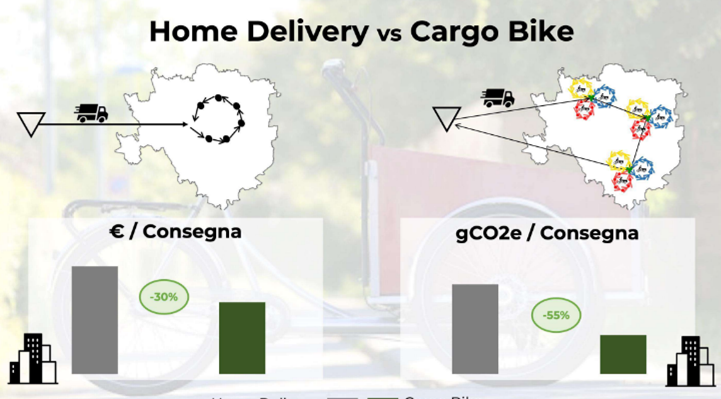
Home Delivery Vs. Cargo Bike. Fonte: Osservatorio eCommerce B2c Politecnico di Milano
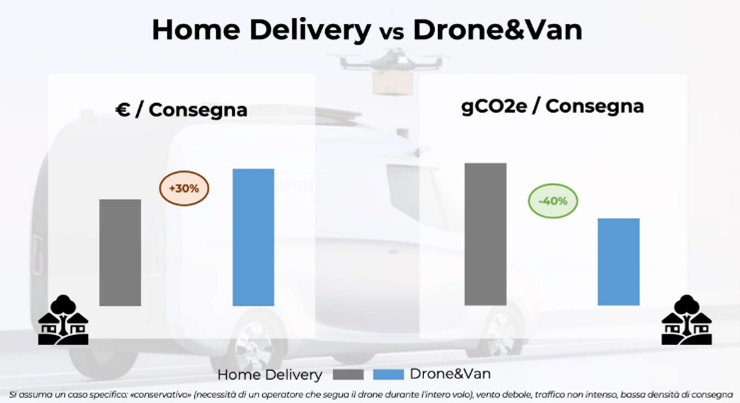
Home Delivery Vs. Drone&Van. Fonte: Osservatorio eCommerce B2c Politecnico di Milano
In other words, using Lockers and Pickup Points for eCommerce deliveries is more sustainable, both environmentally and economically.
If you are an eCommerce manager and would like to integrate tens of thousands of Lockers and Pickup Points already in operation nationwide and internationally to your online store, contact us! GEL Proximity is the answer you’ve been looking for.