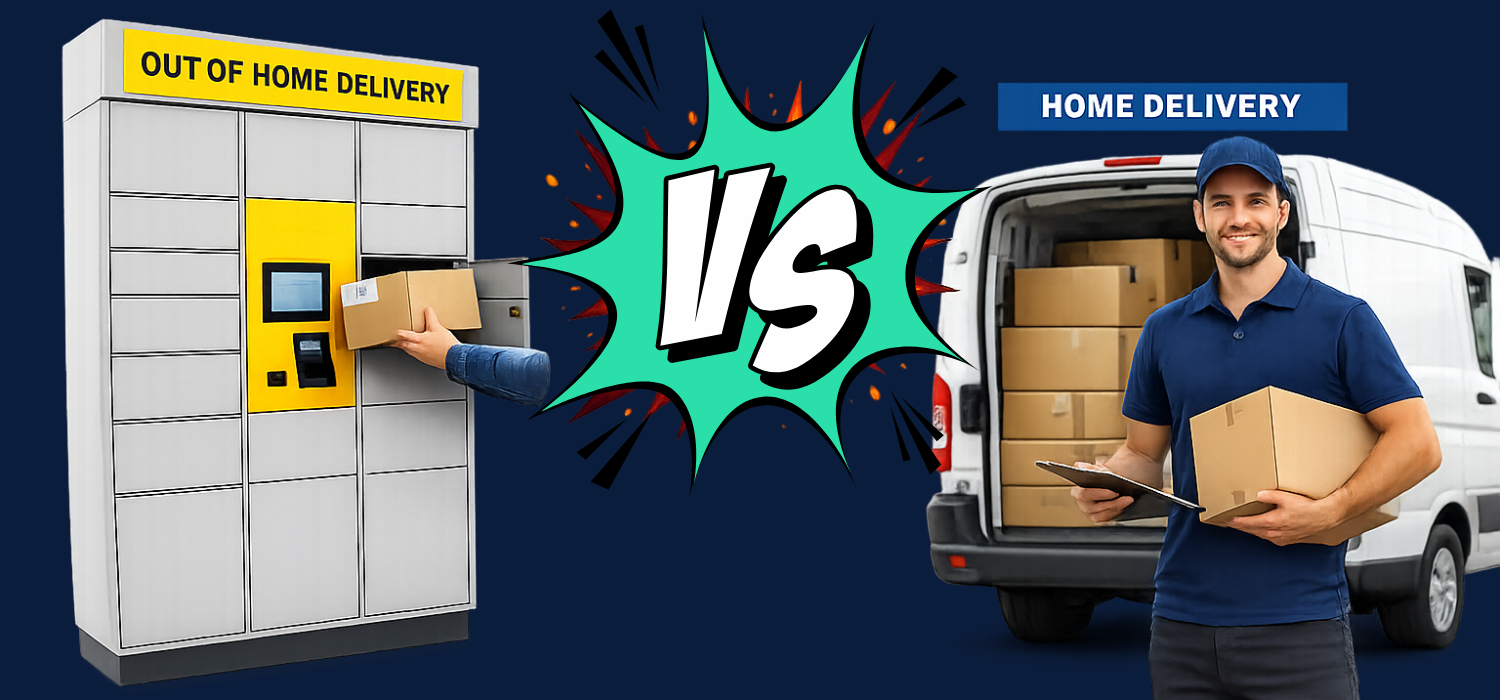

The most common mistake when talking about Out of Home delivery is to consider it simply an additional checkout option, just one more possibility alongside home delivery.
In reality, that’s not the case. Introducing Out of Home delivery into an eCommerce checkout structurally changes the entire logistics flow, from checkout to order management, from fulfillment to delivery execution, all the way through to returns management.
This is where the real operational challenge lies. Because when an eCommerce business or retailer introduces options like Lockers and Pickup Points into the checkout, it doesn’t just change the customer experience, it changes how shipments are assigned, how flows are consolidated, how failed delivery attempts are reduced, and how a more predictable and scalable last mile is built.
In this article, we analyze what actually changes, in concrete terms, when an Out of Home delivery strategy is introduced. We do this by following the order journey from checkout to delivery, to understand where Out of Home simplifies processes, where it increases complexity, and why today it represents a strategic lever for making logistics more efficient, controllable, and sustainable.
1. With Out of Home, the checkout already determines the order’s logistics flow
When a customer chooses a Locker or a PUDO (Pick-Up Drop-Off point) to collect their order, they follow a simple and logical mental process: they select the most convenient option, the one closest to home or work, along their daily routes.
From an operational standpoint, however, the customer’s choice already defines how the entire shipment will be handled. It is no longer a generic delivery to be assigned later, but a flow that is created with a specific constraint, tied to a Pickup Point and a delivery network.
This is where the role of checkout changes. In the traditional model, an address is collected and operational decisions are made later within logistics systems that manage the shipment.
With Out of Home, part of these decisions is anticipated, and the system must adapt in real time to the customer’s choice.
This also has a direct impact on complexity. Offering more delivery options at checkout increases conversion rates, but it makes order management more complex, because it introduces more networks, more variables, and more operational constraints.
The result is simple: checkout stops being just an interface and becomes the point where the logistics flow truly begins.
2. Order management must handle multiple networks simultaneously
In the traditional model, order management follows a simple logic: there is an address, and the shipment is assigned to a carrier. With Out of Home, this linearity disappears.
Delivery is no longer tied to a home address, but to a Pickup Point that belongs to a specific network. This means that assignment is no longer just about the carrier, but about a combination of factors: the point selected by the customer, the network managing it, and the carrier performing the delivery.
In practice, the shipment is already bound to a more complex structure from the outset. While this introduces more variables, it is precisely this complexity that creates value.
Distributing deliveries across multiple networks increases coverage, reduces dependency on a single operator, and allows each shipment to be routed in the most efficient way, based on the selected point and available network.
According to Geopost, today in Europe more than 94% of the population lives within 10 minutes of a Pickup Point. In this context, working with a single carrier is no longer sufficient, as it limits available options and reduces system effectiveness.
The key point is no longer simplifying assignment, but managing greater complexity to achieve more control, broader coverage, and higher efficiency.
3. Fulfillment becomes more predictable because deliveries are concentrated
In the traditional model, as we’ve said, every order has a different destination. This fragments flows and makes it difficult to optimize delivery routes.
With Lockers and Pickup Points, shipments converge toward a limited number of destinations. More orders are routed to the same points, increasing delivery density and reducing the number of kilometers needed to complete routes. The result is immediate: less dispersion and greater operational efficiency.
There is another aspect that should not be underestimated.
Home delivery is inherently unstable: traffic, recipient absence, time constraints. Every route is exposed to variables that are difficult to predict.
Out of Home introduces fixed delivery points, making flows more regular and planning more reliable, because it depends less on last-mile uncertainties or the recipient being at home.
This leads to a shift from a reactive logic—constantly managing exceptions—to a more stable model where flows can be planned and replicated.
The reduction of failed attempts makes the last mile more controllable
Another direct effect of delivery consolidation is the reduction of failed delivery attempts.
In home delivery, recipient absence is one of the main sources of inefficiency. In Europe, between 18% and 22% of deliveries fail on the first attempt, with peaks of 25%, generating additional costs and operational complexity.
With Out of Home, this issue is drastically reduced. Deliveries to Lockers and Pickup Points achieve success rates above 99%, because they do not depend on the customer being at home.
The result is tangible: fewer delivery attempts, lower operational costs, less management and customer care activity. Delivery is no longer a process exposed to hard-to-control variables, but a more stable, standardized flow that is easier to scale.
4. With Out of Home, the customer experience becomes more predictable—not just more flexible
Out of Home changes the type of shopping experience offered to customers.
In the traditional model, home delivery promises convenience, but it also introduces uncertainty: for the customer, who must be at home when the courier arrives, and for the courier, who must respect time windows and manage failed attempts.
With Lockers and Pickup Points, the logic is reversed. The customer no longer has to adapt to the delivery—the delivery adapts to their schedule and needs. They can collect their parcel whenever they want, without time constraints and without depending on the courier.
So the point is not just flexibility, but predictability.
This explains why Out of Home adoption is steadily growing across Europe.
5. The real impact of Out of Home emerges in returns
If Out of Home improves efficiency in delivery, it is in returns management that it truly transforms the operating model.
Returning a product is traditionally one of the most costly and complex processes in eCommerce logistics: it requires home collection or the handling of individual shipments, often fragmented and difficult to plan.
With Lockers and Pickup Points, customers can return products independently at a convenient location, without organizing a pickup or adhering to time constraints.
This has a direct effect on flows: returns are collected at specific points, consolidated, and reintroduced into the logistics system more efficiently, reducing costs and speeding up restocking times.
It is no coincidence that adoption is already very high. According to DHL, 79% of European consumers already use Out of Home solutions for returns.
The real value of Out of Home, therefore, is that Pickup Points become bidirectional logistics nodes, capable of managing both outbound and return flows.
In short, it should now be clear that Out of Home is no longer just an alternative to home delivery, but a structural component of the eCommerce supply chain.
6. By introducing Out of Home, the last mile becomes a coordinated and controllable system
Read the title of this paragraph again, because it is the direct answer to our initial question—the central point of everything we’ve discussed so far.
What really changes when you introduce Out of Home into your shipping strategy? The last mile becomes a coordinated and controllable system.
With Out of Home, the logistics flow is no longer built step by step—it starts at checkout. The choice of Pickup Point influences routing, fulfillment, and the entire delivery execution. The result is a more integrated, predictable, and scalable system, where the last mile stops being the weakest point of the supply chain and becomes a manageable process.
For eCommerce businesses, this means one thing: moving from a reactive logic to a more efficient, controllable, and scalable model. The question that remains, if you are an eCommerce manager, is: how do you do it?
The answer is to adopt a technology capable of managing Out of Home as a system, exactly what GEL Proximity does, allowing you to access a network of over 500,000 Pickup Points and Lockers across Europe and to integrate deliveries and returns into a single platform.
Curious to learn more? Request a demo now!