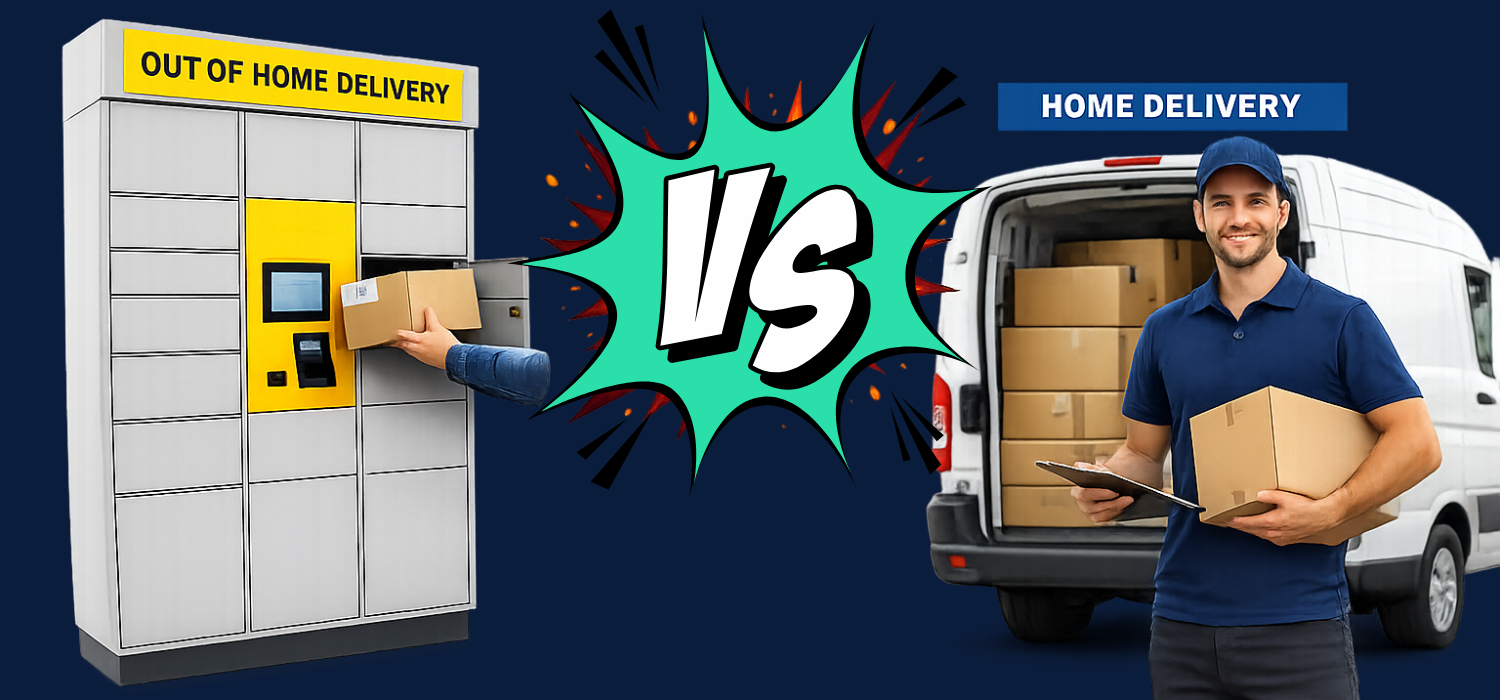

Italian eCommerce continues to grow, but operational complexity, last-mile costs, and consumer expectations are increasing as well. In this scenario, Out of Home delivery is no longer just an alternative to home delivery, but a true strategic lever for retailers and logistics operators.
In 2025, the Out of Home model entered a new phase of maturity, and the data confirms it. For those operating in digital retail and logistics, understanding its evolution is now a strategic choice.
It means rethinking delivery infrastructure, evaluating the integration of Pickup Points and Lockers into checkout flows and management systems, redefining last-mile costs, and designing a delivery experience aligned with consumers’ expectations for flexibility and control. In other words, Out of Home delivery is not just an additional option, but a factor that directly impacts margins, conversion rates, and competitiveness.
In this article, we analyze the state of the art of Out of Home delivery in Italy in 2025, with a focus on Pickup Points and Lockers, market data, European trends, and operational impacts for logistics operators and online merchants. The goal is to provide an updated overview of out-of-home deliveries, the role of PUDO networks, and the concrete opportunities to integrate Out of Home delivery into eCommerce systems and distribution models.
Italian eCommerce in 2025: volumes, growth, and new purchasing habits
According to the 2025 edition of Netcomm NetRetail, online shoppers in Italy have reached 34.9 million, equal to 82% of Italian Internet users. Of these, 25.9 million are habitual buyers, meaning they purchase online at least once a month.
In the first quarter of 2025 alone, 211 million online purchases were recorded, while the total value of Italian eCommerce was estimated at €88 billion. Moreover, online now accounts for approximately 10% of total household consumption in Italy.
Another relevant figure concerns the composition of purchases: 74.4% of transactions completed in 2025 involve physical products. This means increasing pressure on logistics and, in particular, on the last mile.
In short, faced with growing volumes, higher purchase frequency, and the increasing weight of physical products, the question is no longer whether last-mile logistics must evolve, but how to do so in a sustainable and efficient way.
The structural limits of home delivery
Failed deliveries and hidden costs
The door-to-door model presents structural inefficiencies that directly affect operating costs. According to the Out of Home Delivery in Europe 2025 report by Last Mile Experts, in some European countries up to 25% of first delivery attempts may fail.
Each failed delivery attempt entails significant additional costs, as well as negative impacts on customer satisfaction and sustainability.
In a context of rising labor costs and margin pressure, home delivery is therefore progressively turning into a premium service, no longer economically sustainable for all product categories.
Consumer expectations: flexibility first
On the demand side, expectations are also being redefined. The Delivery & Returns Report 2024 by DHL highlights that 48% of global shoppers abandon their cart if they do not find their preferred delivery option. In addition, 37% would like to choose a time slot or receive a more precise delivery window.
The message is clear: offering multiple delivery options is no longer an ancillary service, but a factor that directly impacts conversion rates.
Out of Home delivery: scale and maturity of the model in Europe
While Italy is accelerating, Europe today represents the most advanced laboratory for Out of Home.
According to the 2025 report by Last Mile Experts, there are a total of 646,480 OOH points active in Europe. Of these, 462,080 are PUDO points and 184,400 are Automated Parcel Machines (i.e., Lockers).
These are no longer experimental networks, but widespread infrastructures integrated into the systems of major CEP (Courier, Express and Parcel) operators. Major European carriers manage hundreds of thousands of out-of-home Pickup Points, a sign of a now structural transformation of the distribution model.
Operational efficiency and sustainability: the competitive advantage of OOH
Out of Home is not only a response to consumers’ growing demand for flexibility, but also a lever for operational efficiency.
Greater delivery productivity
In Poland, for example (one of the most mature markets), a courier can deliver up to 1,500 parcels per day to Lockers during seasonal peaks, compared to 150–250 with door-to-door delivery. The difference in productivity is evident.
Reduction of environmental impact
Environmental benefits are also significant. Out of Home solutions can contribute to CO₂ emission reductions of up to 82% per delivery, thanks to higher delivery density and fewer failed attempts.
Operational impacts for eCommerce and logistics operators
For eCommerce companies and logistics operators, this translates into:
- lower cost per delivered parcel;
- greater predictability of flows;
- improvement of ESG indicators.
Italy: acceleration phase and new opportunities
Let us now analyze the state of Out of Home in Italy.
The Italian market is in a phase of eCommerce consolidation and progressive adoption of alternative delivery models.
With 34.9 million online shoppers and a growing share of physical product purchases, demand for flexible solutions is set to increase. At the same time, omnichannel strategies and the integration of digital touchpoints increasingly influence the customer journey.
In this scenario, Out of Home delivery is not merely an alternative channel to home delivery, but a true enabler of more advanced business models.
Evolution of omnichannel strategies
From an omnichannel perspective, Lockers and Pickup Points go beyond traditional click & collect tied exclusively to physical stores, extending the pickup network at urban and national scale. This enables retailers to offer more widespread collection options and allows customers to choose where and when to receive or return a product. Likewise, the presence of widespread OOH networks facilitates the management of distributed returns, reducing reverse logistics costs and simplifying the post-purchase experience.
International expansion and cross-border
For merchants operating on marketplaces or selling cross-border, Out of Home also becomes a strategic lever for international expansion. Access to well-established Locker and Pickup Point networks in major European markets enables the offering of delivery options aligned with local habits, increasing conversion rates and reducing operational complexity.
Economic efficiency for marketplaces and sellers
Finally, from an economic perspective, the concentration of deliveries at OOH points enables greater route efficiency, with a direct impact on cost per parcel. For high-volume marketplaces and sellers, this means containing shipping costs, preserving margins, and sustaining competitive delivery policies without compromising service quality.
The crucial step, however, is not only expanding the physical network, but making it interoperable and easily integrable into eCommerce systems and operators’ TMS/WMS platforms.
Why OOH is strategic for eCommerce and logistics operators
The adoption of Out of Home delivery responds to four main drivers:
- Cost reduction and higher margins: delivery concentration and fewer failed deliveries improve the cost structure;
- Customer experience and conversion rate: offering Lockers and Pickup Points as delivery options increases the likelihood of purchase completion;
- Returns management: OOH enables simpler and more scalable reverse logistics flows, a key element in high-return sectors such as fashion and electronics;
- Technological scalability: with increasingly open and shared European networks, the real differentiating factor becomes the ability to quickly and easily integrate hundreds of thousands of pickup points into one’s systems.
In this scenario, technological solutions such as GEL Proximity, capable of connecting over 500,000 Pickup Points and Lockers into a single interoperable infrastructure, represent a concrete accelerator for those who want to evolve their logistics offering and integrate Out of Home into their systems.
To further explore data, trends, and real-life use cases, these topics will be at the center of the webinar “Crazy About Out Of Home: the new era of eCommerce deliveries. Data, trends and success cases,” organized by Netcomm Academy and curated by GEL Proximity, scheduled for January 29.
For those operating in logistics and digital commerce, understanding the role of Out of Home today means preparing for a market in which flexibility, operational efficiency, and technological integration are no longer options, but competitive prerequisites.
Register for the webinar and discover how to integrate Out of Home into your eCommerce logistics and delivery strategy, or contact us for more information!