
The last mile is one of the main cost drivers and operational challenges for eCommerce companies and logistics operators. As eCommerce volumes continue to grow, merchants and carriers are increasingly facing a clear challenge: home delivery is expensive, difficult to scale, and often inefficient.
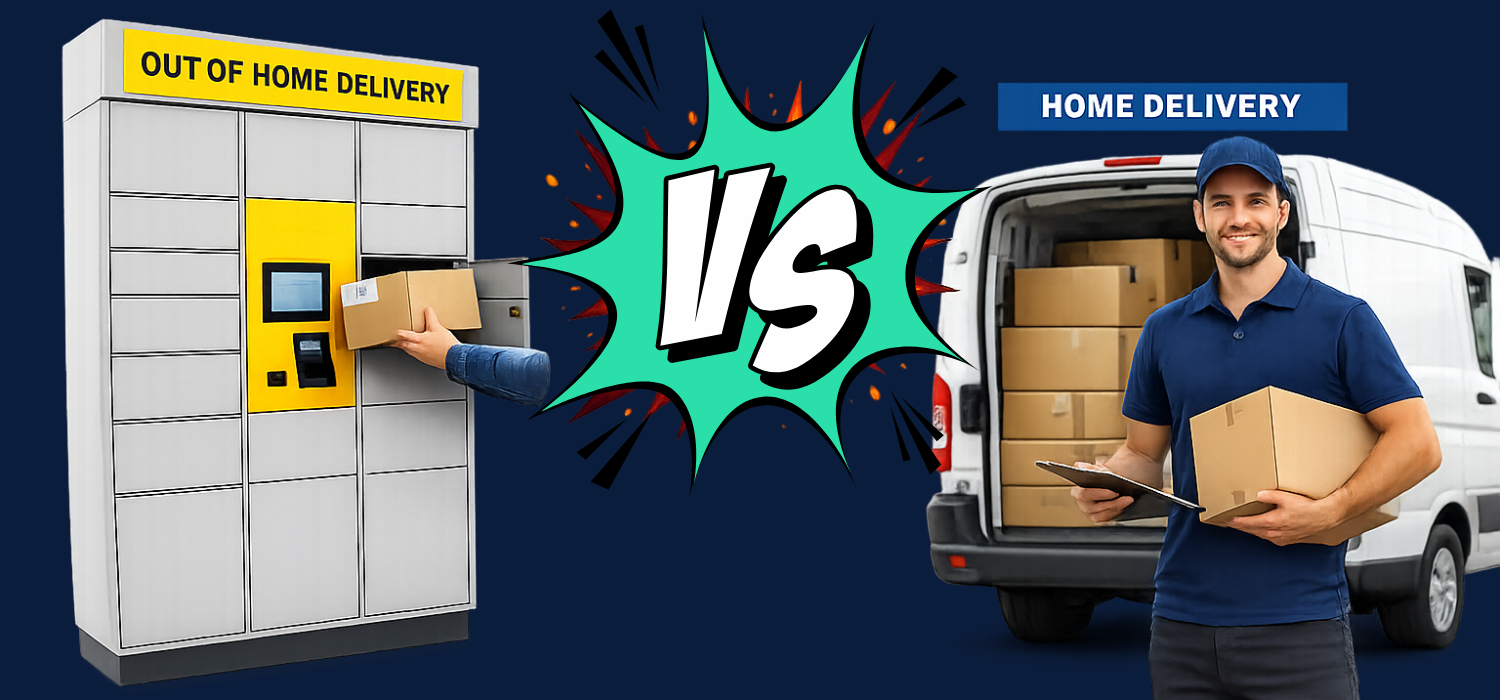
For this reason, many companies are accelerating the adoption of Out of Home delivery models, meaning deliveries to Pickup Points and Parcel Lockers.
The reason is not only operational but above all economic: in several European markets, home delivery can cost up to nearly three times more than Out of Home delivery.
In this article, we compare the costs of Out of Home delivery with those of home delivery, helping you understand which delivery models are more efficient in eCommerce logistics and how to rethink your last-mile delivery strategy.
Last-mile delivery: why it is the most expensive stage of eCommerce logistics
That last-mile delivery is the most expensive part of eCommerce shipping is now a well-established fact.
The last mile can represent up to 41% of total supply chain costs, and the reason is simple: it is the least efficient phase of the entire logistics process.
A significant share of these costs is mainly linked to the home delivery model, which involves several operational inefficiencies that are difficult to eliminate:
-
High number of stops per delivery: in home delivery, every parcel requires a dedicated stop. The courier must reach the address, find parking, deliver the parcel and move on. In urban environments this often means traffic, waiting time and limited productivity for each delivery round.
-
Low delivery density: unlike other logistics models, door-to-door distribution does not allow many shipments to be concentrated in the same location. The result is a fragmented delivery network, with longer routes and higher operational costs.
-
Failed deliveries and additional attempts: recipient absence is one of the main inefficiencies of home delivery. When delivery fails, the parcel must be handled again: a new delivery attempt, temporary storage or pickup at a logistics point, all of which generate additional operational and customer service costs.
-
Routes that are difficult to optimize: door-to-door distribution makes route planning more complex. Addresses are scattered and variable, making it difficult to create truly efficient itineraries compared to models based on centralized delivery points.
The result? An operational structure that struggles to maintain sustainable margins.
Pickup Points and Lockers: how much can you save compared to home delivery
An increasingly widespread alternative today is represented by Out of Home delivery models, which include Pickup Points located in shops or commercial businesses and automated Parcel Lockers.
These models allow multiple deliveries to be concentrated in a single location, significantly increasing logistics efficiency.
Cost comparison of last-mile delivery across 17 European markets
When comparing last-mile delivery prices across different European markets, one recurring trend clearly emerges: home delivery is significantly more expensive (up to three times more) than delivery via Parcel Locker.
Data collected by Tembi – Market Intelligence, also cited by industry expert Andre Veskimeister, shows that lockers consistently represent the most cost-efficient option.
To mention just a few notable examples:
-
Bulgaria: Locker delivery €2.49 vs Home delivery €4.59
-
Latvia: Locker €3.41 vs Home delivery €9.72
-
Germany: Locker €7.22 vs Home delivery €10.69
-
Finland: Locker €6.51 vs Home delivery €12.11
“The pattern that emerged from the analysis,” writes Veskimeister, “is clear: in every analyzed market, lockers are the most economical delivery channel.”
Why Out of Home delivery costs less than home delivery
The economic advantage of Out of Home delivery does not depend only on the final price, but on a structurally more efficient logistics model.
-
Much higher delivery density: a courier performing home delivery must stop once for each parcel. With a locker, dozens of shipments can be deposited in a single stop. A single Pickup Point can receive 10–50 parcels at once, drastically reducing stop time, kilometers traveled and labor costs.
-
Elimination of failed deliveries: in Out of Home systems, parcels are deposited in locations accessible to customers at any time. This removes one of the main problems of home delivery: the absent recipient. Fewer failed delivery attempts mean fewer operational costs, fewer customer service issues and less unnecessary logistics traffic.
-
Optimized delivery routes: lockers and Pickup Points create high-density delivery hubs. This enables logistics operators to design far more efficient routes compared to door-to-door distribution, with direct benefits in fuel consumption, travel time and fleet utilization.
The evolution of European markets: where lockers are already the dominant channel
An interesting trend emerges when observing European markets where lockers are already widespread and considered “locker-first markets.”
In countries such as Estonia, Latvia, Lithuania, Poland and the Czech Republic, Out of Home delivery is no longer just an alternative to home delivery — it has already become the preferred option for consumers.
This does not mean that home delivery has completely disappeared. When lockers absorb most high-density urban deliveries, home delivery remains useful mainly for rural areas that are harder to reach or for truly urgent shipments.
As a result, home delivery tends to become a premium service, reserved for the most complex deliveries.
Why Out of Home delivery benefits eCommerce businesses and logistics operators
For merchants and logistics operators, this market transformation has very concrete implications.
-
Reduced shipping costs: integrating Out of Home options at checkout helps reduce average shipping costs, especially in high-volume eCommerce markets. For merchants, this translates into more sustainable margins, more competitive shipping rates and greater control over logistics costs.
-
Greater operational scalability: OOH models are inherently more scalable than door-to-door delivery. As eCommerce volumes grow, networks of lockers and Pickup Points can manage higher flows without proportionally increasing operational resources.
-
More flexible customer experience: customers can choose when and where to collect their parcels, without needing to stay home waiting for the courier — a solution that also guarantees greater privacy.
At this point, the real question for eCommerce companies and logistics operators is no longer whether to adopt these solutions, but how to integrate them quickly and at scale into their logistics systems.
And this is where GEL Proximity comes in. Our technology allows you, through a single integration, to access a network of over 500,000 Pickup Points and Lockers already active across Europe. This enables you to quickly offer Out of Home delivery options to your customers without dealing with complex integrations with each individual network.
The data is clear: concentrating deliveries in Lockers and Pickup Points increases operational efficiency and reduces last-mile costs.
What are you waiting for? Contact us now for a personalized demo!