
Lockers, pickup points and micro-hubs can make last-mile delivery more efficient. To bring them together into a coordinated network, operators need reliable information, connected systems and clear rules for working together.
Take a parcel arriving at a micro-hub on the edge of a historic city centre. The carrier leaves it in a compartment and continues its round. A local operator collects the parcel and completes the delivery using an electric vehicle. It sounds straightforward, but the handover takes precise coordination. Which shipment is due to arrive? Where can it be deposited? Who is authorised to collect it? And how is the transfer from one operator to the other recorded?
The future of urban logistics depends in part on how well these handovers work. Shared information and coordinated procedures allow physical infrastructure, software and different organisations to work together.
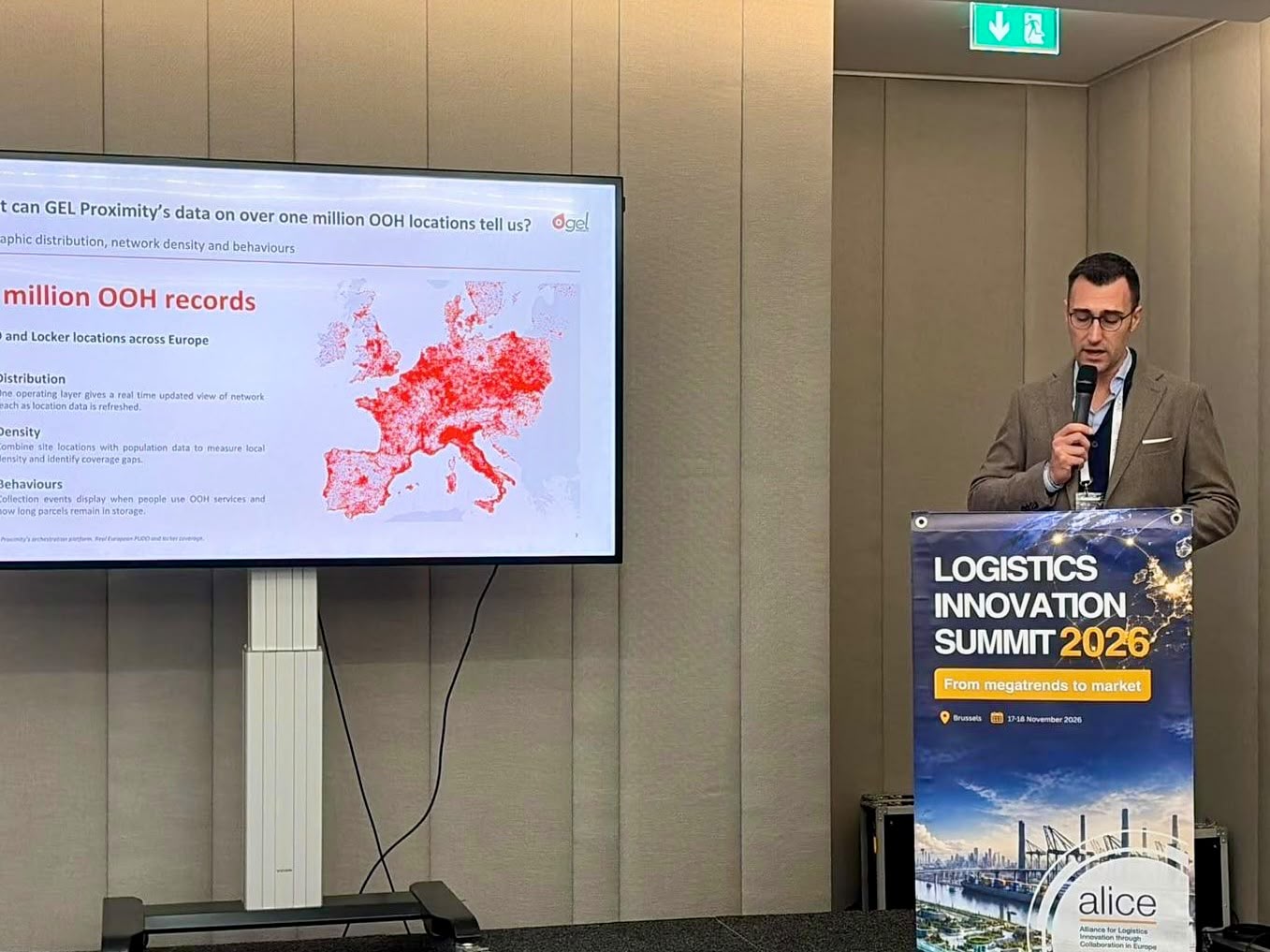
This was the focus of the talk given by Lorenzo Maggioni, CEO and co-founder of GEL Proximity, at the ALICE Logistics Innovation Summit 2026 in Brussels on 18 November. In his talk, “Connecting Urban Logistics: Data, Interoperability and the Future of Shared Infrastructure”, part of the session “Transforming urban data into action enabler”, he explored the role of data and digital orchestration in developing shared urban logistics networks. Here, we look at how to connect infrastructure and operators, what information helps improve delivery planning and what we can learn from projects already under way.
Out-of-home networks are growing. How can we connect them?
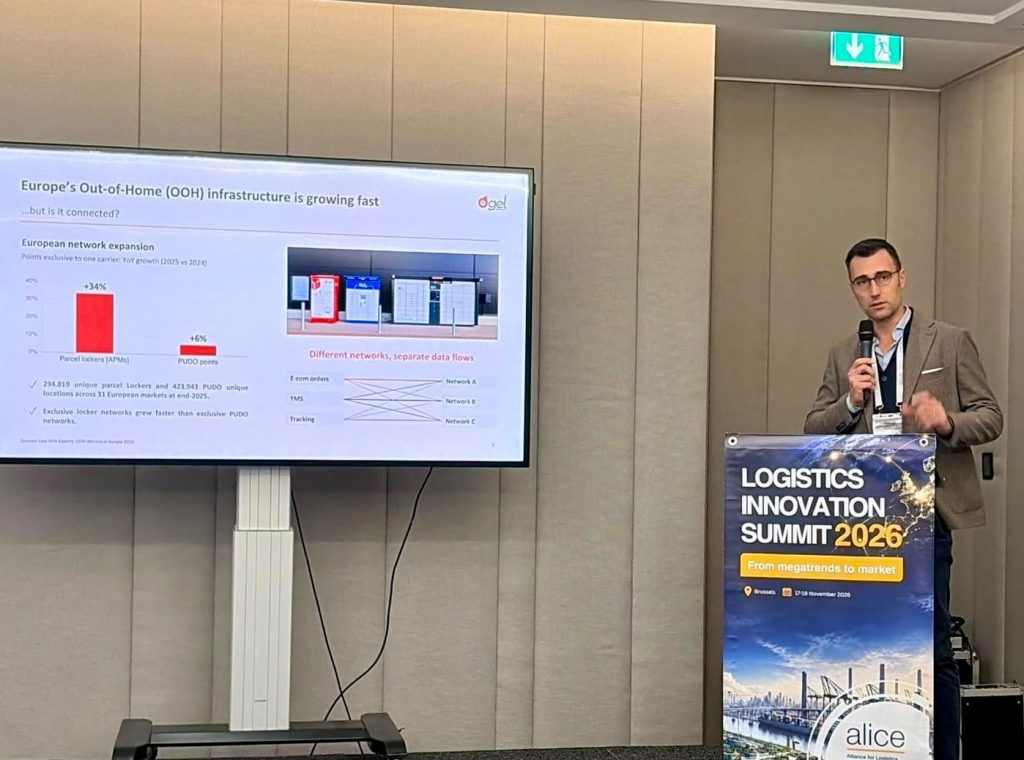
As out-of-home delivery becomes more widespread, it opens up more ways to organise last-mile operations and make them more efficient. According to Last Mile Experts’ Out-of-home Delivery in Europe 2026 report, by the end of 2025 there were more than 294,000 lockers and 423,000 unique PUDO locations across 31 European markets. Compared with 2024, single-carrier networks grew by 34% for lockers and 6% for PUDO locations.
That growth also creates an operational challenge. Different networks can continue to rely on separate data flows, tracking systems and shipment handling procedures.
A network’s value depends on both its reach and how well it can be used in a coordinated way. That means knowing which locations are available, connecting them to logistics systems and managing handovers between the operators that serve them.
What parcel collection data tells us
Data from out-of-home deliveries helps us understand how the available infrastructure is used. The location of lockers and pickup points shows how much of an area the network covers. Collection records and the time parcels spend at these sites help operators assess demand, accessibility and how quickly storage space becomes available again.
According to GEL Proximity data presented at the ALICE Summit, 35.6% of collections in the Italian network studied take place between 5 and 8 pm, and parcels stay at lockers and pickup points for an average of 1.43 days. A further 3.06% of collections take place between 10 pm and 6 am. The figures by time of day cover both staffed pickup points and lockers.
These figures raise practical questions. Does a site have enough capacity during its busiest hours? Does the time parcels spend there limit compartment availability for new deliveries? Can customers get to the site during its access hours?
Overnight collections show that people use the service outside typical shop opening hours. When deciding where automated lockers might extend access, operators need to consider this figure alongside where existing facilities are located and when and how people can access them. By itself, it captures only part of the potential demand.
Average dwell time also needs context. To size an individual site, operators need to know its parcel volumes, how usage varies by day of the week and what types of compartments it offers. The network-wide average is a starting point for a more focused analysis.
What interoperability means for shared infrastructure
A micro-hub open to multiple operators gives them a shared space to deposit and transfer goods. To use that space effectively, they need to coordinate their activities even when they use different technologies.
In urban logistics, interoperability means that systems can exchange information that each can use to carry out a shared process. An operator’s management system must be able to report that a shipment is arriving. The micro-hub’s software must manage drop-off and access. The final delivery operator must receive the information it needs to collect the shipment.
Consider a shipment that changes hands at a micro-hub. If only the first carrier’s system records the drop-off, the operator completing the delivery may have no way to see that it happened. The drop-off record therefore needs to be linked to the correct shipment and made available to the authorised operator.
Sharing a physical space also requires agreement on shipment identifiers, shipment statuses, access permissions and how operators confirm that they have taken custody. This gives everyone involved a way to verify handovers.
The role of digital orchestration in the last mile
Digital orchestration connects systems and coordinates activities throughout the logistics process. For shared infrastructure, it connects operators’ software, transport management systems, lockers and micro-hubs.
In the projects GEL Proximity presented at the summit, the orchestration platform coordinates orders, shipment bookings, access to micro-hubs and handovers between operators. Compartment allocation and capacity management depend on what the hardware can do and which integrations are available.
Coordination also involves deciding what information each participant can access, for which activities and with what permissions. Multi-operator infrastructure needs rules that allow participants to exchange the information required to run the service and protect the data they share.
A neutral orchestration platform helps different operators work under agreed rules and trace when responsibility passes from one to another. The technology supports that collaboration, and the participants also need to agree on how they will work together.
How Bologna and Rimini use shared micro-hubs
In Bologna, the European URBANE project piloted automated, carrier-agnostic micro-hubs that multiple operators could use to serve the city’s limited traffic zone. Carriers hand parcels over to last-mile operators, who deliver them to recipients using electric vehicles.
GEL Proximity’s technology connects the participants and coordinates shipment flows, compartment allocation and handovers. The micro-hub serves as a transfer point, allowing transport into the city centre and local distribution to be organised separately.
In Rimini, the HORECA LAST MILE project applies the same principle to food deliveries for hotels, restaurants and catering businesses. It combines a refrigerated micro-hub open to multiple operators, GEL Proximity’s orchestration platform and refrigerated cargo bikes for urban deliveries.
Food deliveries also have specific storage requirements. In the Rimini project, the refrigerated facility serves as a transfer point between suppliers and final delivery operators, with the aim of maintaining the cold chain.
Together, the two projects show how the same approach can support different types of goods. Parcels and food ingredients have different equipment, timing and handling requirements. In both cases, multiple operators need to coordinate the process.
Using data to make urban logistics decisions
For cities, these models raise two planning questions. Where should the infrastructure go, and how can its benefits be assessed?
Choosing a site means looking at delivery demand alongside operators’ routes, accessibility and available space. Walking distances and opening hours also matter for consumer pickup services. For a distribution micro-hub, the main considerations are how it fits into delivery rounds and how operators can access the area it serves.
Cities also need clear rules on the use of space, the duration of permits and who is responsible for day-to-day operations. When a site is open to multiple operators, access and data management arrangements need to make sharing workable.
The next step is to measure results, including compartment utilisation, shipment volumes, handover reliability, distances travelled and environmental impacts. Any reductions in traffic and emissions should be measured against the baseline, taking into account any additional journeys the model generates.
The future of shared infrastructure depends on using operational evidence to make local planning decisions. For GEL Proximity, digital orchestration makes it possible to connect operators and infrastructure, manage the transfer of goods and generate data that can be used to improve the service.