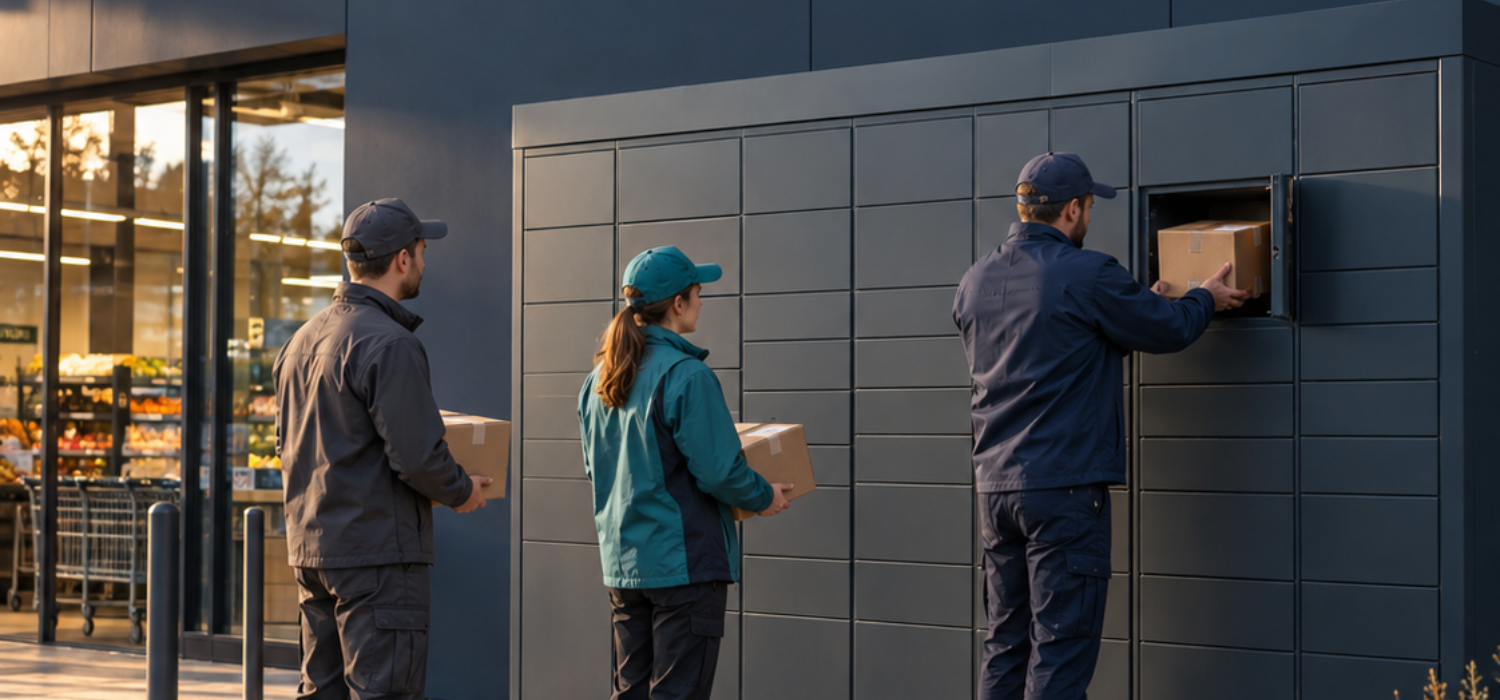

Does adding services increase the value of a locker network, or could it take up space needed for deliveries and returns? The question stems from some recent news that caught our attention. For example, in July this year, Bpost introduced Bbox Rent & Store in Belgium, a service that allows anyone to rent a parcel locker compartment to store personal belongings or leave them for someone else.
For Out-of-Home network operators, this is certainly an interesting opportunity: offering new services and generating additional revenue through infrastructure already in place. A network originally designed to handle parcels can also meet other everyday needs, from temporary storage to exchanging items. However, the available space remains the same, and different uses involve different occupancy times that must fit alongside the steadily growing flows of eCommerce deliveries and returns.
The challenge, then, is to understand which services can coexist and how to coordinate them so that expanding the offering also benefits those who use the network to send, collect and return their purchases.
Parcel lockers for exchanges between individuals: the InPost precedent
Using an existing parcel locker network to exchange items between individuals is not entirely new.
Back in 2020, InPost introduced Podaj Dalej in Poland, a service that allowed users to drop off and collect a parcel at the same locker.
The idea behind the service addresses a specific need: leaving an item for someone without having to arrange a meeting. In practice, one person drops off the parcel and another collects it whenever convenient. The locker becomes the exchange point, without the parcel needing to be transported elsewhere.
What makes this interesting is how a network already used for parcel shipping can also provide a local service, making use of locker locations and allowing different users to access them at different times.
For users, the benefit is greater flexibility and the ability to arrange the exchange around their respective schedules. For the operator, it represents an additional use to integrate into network operations, with procedures for authorising collection, notifying the recipient and managing uncollected parcels.
Parcel lockers for local retail: collection beyond shop opening hours
The ability to drop off and collect an item at different times can also benefit local retailers. In Ostend, for example, Bpost’s Bbox City Network project includes Shop & Collect, a service through which retailers can prepare orders and leave them in lockers for their customers.
The process is similar to an exchange between individuals, but is integrated into the sales process: the retailer deposits the purchase and the customer collects it whenever convenient, even after the shop has closed. Retailers can therefore offer greater flexibility without extending their opening hours or arranging home delivery.
However, the convenience of the service depends first and foremost on the locker’s location. If customers can collect their purchases on their way home from work or while running other errands, collection fits easily into their day. If it requires a separate trip, the advantage over visiting the shop may be less significant.
From an operational perspective, retailers need to be able to rely on a compartment being available when an order is ready. Customers should receive a notification only once their purchase has been deposited, together with collection instructions and a deadline. Coordinating these steps prevents wasted trips and allows retailers to offer a reliable service beyond their opening hours.
More services, the same available space: how can capacity constraints be managed?
Making all these services coexist also means dealing with the available space. A compartment used to store a personal item cannot simultaneously accommodate a delivery or a return. As demand grows, operators must therefore decide how much space to allocate to each use and for how long.
Counting empty compartments is not enough. Operators need to know their sizes, when occupied compartments will become available again, and how many parcels are expected over the following hours or days.
The issue becomes more apparent during eCommerce peak periods, when even a few unavailable compartments can force parcels to be redirected to other locations.
These decisions also affect financial performance. Revenue from an additional storage service must be weighed against the costs it may generate: from managing an extended storage period to rerouting a delivery or supporting a customer whose preferred location is unavailable. Increasing the number of uses a network supports does not, in itself, guarantee greater profitability.
To strike a balance, operators can limit storage durations, reserve some compartments for deliveries and returns, or reduce the availability of additional services during busy periods. There is no single answer. The right choice depends on local demand and actual collection times. This data helps operators identify where to expand their offering and where to preserve space for existing flows.
Why orchestration is essential to locker management
Applying these rules requires communication between those who manage the lockers and those who use them to provide different services. When a retailer deposits an order or a customer extends an item’s storage period, compartment availability changes. That information must also be updated in the systems used to organise deliveries and accept new storage bookings.
In a shared network, logistics operators, retailers and infrastructure managers must therefore be able to exchange information on the status of operations. A purchase that is ready in the shop is not yet available for collection; an allocated compartment is not necessarily already occupied. Distinguishing between these stages makes it possible to send notifications at the right time, authorise access and take action when an item remains in a locker beyond the agreed deadline.
Orchestration coordinates this information and applies the rules established for the network. By connecting the systems involved, it allows different flows to be managed according to space availability and the priorities assigned to each service. Operators can then assess whether and where to accept a new storage booking, while also taking expected deliveries into account.
Activating an additional service still requires the locker to support it, the software to handle the relevant operations, and agreements to be established with the network operator. These conditions make the infrastructure usable for different needs in practice.
GEL Proximity and Out-of-Home network management
Connecting networks and operators through a single technology is the principle behind GEL Proximity. For eCommerce deliveries and returns, the platform provides access to over 1,000,000 lockers and pick-up points through a single integration. Merchants can expand the options available to their customers without developing and maintaining a separate connection to each network.
In urban logistics, the GEL Proximity orchestrator connects operators and systems and supports the management of automated lockers and storage spaces. It allows operational cut-off times to be defined and the occupancy of spaces used to hold goods to be managed, coordinating flows involving couriers and last-mile operators.
This approach is also relevant as networks evolve to offer more services, whose activation must be assessed with the infrastructure operators involved. Personal storage and local exchange services show that opportunities exist. Turning them into a reliable offering requires every new use to be integrated into network management.
The answer to the initial question therefore depends on this balance: adding services can increase the value of lockers when capacity is managed to support new uses while continuing to ensure space for deliveries and returns.
Do you manage a locker network or want to improve your Out-of-Home flows? Discover the GEL Proximity orchestrator and request a demo to explore the right solutions for your business.