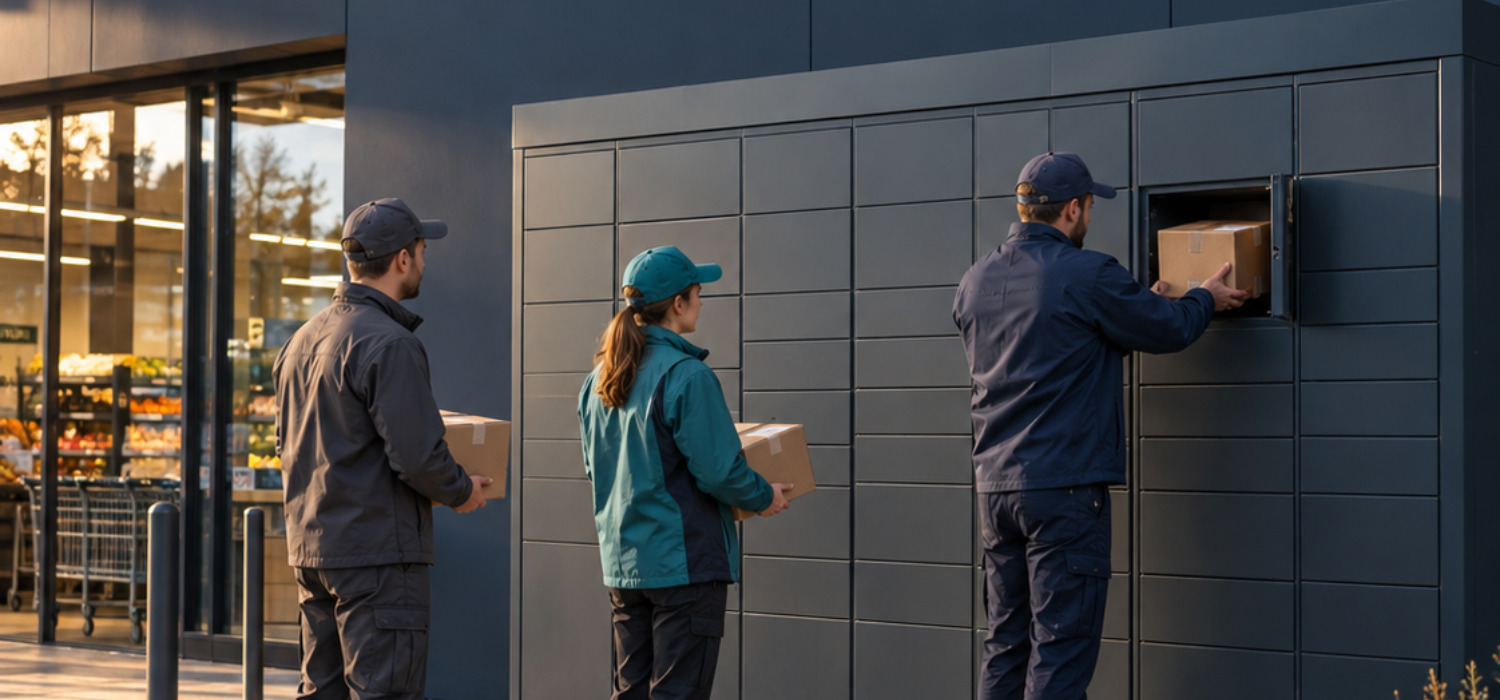

Let’s start with a scene: a courier arrives at a supermarket. There is a parcel locker at the entrance, convenient for people who live in the neighbourhood and those stopping by to do their shopping. Yet the parcel in the van cannot be dropped off there: that locker only accepts shipments from another operator. To offer a collection point in the same area, the courier has to find a different location or install its own locker.
This is more than an imagined scenario. It is a common situation that highlights one of the challenges of Out-of-Home delivery: making existing locker and collection point networks accessible to multiple operators. A good location can only go so far if each network remains available exclusively to the operator that controls it.
So how can this work in practice?
Some companies in Europe are already working on an answer. In March 2026, GLS and DPD announced inboxx in Germany, a joint brand for an open network of collection points and lockers. By the end of 2027, they aim to share 20,000 Out-of-Home points, including up to 6,000 lockers. These are announced targets, rather than locations that are all already operational. They nevertheless show how important connecting different operators to the same infrastructure has become.
What are carrier-agnostic lockers, and how does a shared network work?
“Agnostic” towards whom? Carriers, network operators and manufacturers
A locker is carrier-agnostic when it can handle shipments from multiple carriers, under the agreements and access rules established by the network operator.
This does not mean that anyone can leave a parcel in any compartment. Each carrier must be authorised, the requested service must be supported, and the location must have available capacity. What sets this model apart, and creates its benefits, is the ability to share a location rather than reserve it for a single fleet.
For a carrier, this means being able to add delivery and collection points without necessarily installing its own infrastructure in every area. For a locker network operator, it means handling parcel volumes from multiple carriers and making better use of available capacity.
There is, however, an important distinction. The word “agnostic” is also used to describe software that is compatible with lockers from different manufacturers. This is another form of openness that helps operators manage installations using different types of hardware, but it does not, on its own, determine which carriers can use them. The distinction matters: infrastructure can be technologically flexible while remaining operationally closed.
In this article, we focus primarily on networks open to multiple delivery carriers.
What changes when multiple carriers use the same locker?
In a network reserved for a single carrier, compartment availability only concerns that carrier’s shipments. When multiple carriers use the network, capacity is shared. The system must therefore determine which parcels, and how many, can arrive at each location, record drop-offs and collections, and communicate each event to the carrier responsible.
Opening up a network involves more than providing physical access to a locker. It requires common rules and up-to-date information. If the availability shown in carriers’ systems does not reflect actual capacity, sharing can result in a parcel arriving at its destination with no compartment available.
Why operators are investing in open locker networks
More volume through existing locations, less duplication of networks
For a company managing a locker network, opening access to multiple carriers means increasing the volume of parcels passing through locations already installed.
For a carrier, using those locations means expanding its Out-of-Home options without having to build its own infrastructure in every area.
For an eCommerce business, it means being able to offer customers locations that are closer to them or better suited to their habits and needs.
The economic appeal is clear, but savings are not automatic. Results depend on network density, actual parcel volumes, access terms and the quality of integrations. A shared location works best when it receives enough parcels to justify its presence while retaining sufficient capacity to serve the operators that rely on it.
The operational challenge: access, capacity and parcel flow management
Peak periods are when the model is put to the test. If parcels remain in lockers longer than expected, or returns are not collected within the agreed timeframe, availability decreases just as demand rises. Rules governing storage times, full compartments and responsibility for service failures then become part of the service, rather than details to address after installation.
That is why anyone planning a multi-carrier network needs to look at parcel flows as well as the map: how many shipments arrive in an area, how long they occupy a compartment, and how frequently an operator can collect them.
Adding physical locations expands coverage; managing them determines whether that coverage is usable on the busiest working days.
From open networks to interoperable networks: the role of technology
A single connection to access multiple Out-of-Home solutions
For an eCommerce business, the existence of an open network is only the first step. The central issue is network interoperability. In practice, a customer can only select a locker at checkout if the online store knows which locations are accessible for that shipment and can pass the selection on to the carrier. Adding different networks one at a time involves separate integrations, updates and rules, including for returns. Delivery choice truly expands when this work can be managed without rebuilding the connection between systems each time.
GEL Proximity enables eCommerce businesses to manage this connection through a single integration, giving them access to over 1,000,000 collection points and lockers across different networks and allowing them to incorporate these locations into their delivery and returns processes.
From network access to delivery coordination
The challenge becomes more complex for carriers and logistics operators that need to connect their systems with lockers, micro-hubs and last-mile delivery providers. A parcel may pass through several organisations before collection, and at every stage it must be clear who is responsible for it and which event needs to be recorded. This is where interoperability moves beyond the promise of more available locations and becomes a matter of coordinating operations.
GEL Proximity’s last-mile orchestrator is designed for this level of coordination: it connects multiple logistics operators, manages handovers to final-mile delivery providers and monitors parcel flows. It can connect locker or micro-hub software with carriers’ transport management systems. For businesses that already have a fleet or shipping agreements in place, the value lies in connecting them to new urban nodes while maintaining visibility over each parcel’s journey.
The future of lockers depends on shared access
The growth of open networks does not remove the need to install new lockers, but it does change the criteria used to assess them. Before adding a location, it is worth asking who will be able to use it, which parcel flows it can accommodate, and how it will connect to eCommerce and transport systems. A well-positioned location becomes more valuable when it is accessible to multiple carriers and that access translates into shipments that can actually be handled.
For eCommerce businesses, what matters is a reliable delivery option. For carriers and logistics operators, it is the ability to expand coverage while maintaining control over operations. Carrier-agnostic locker networks can meet both needs when open infrastructure is supported by operational rules and technological connections that make it work every day.
Would you like to integrate collection points and lockers into your eCommerce business, or connect your network to parcel flows from multiple operators? Contact us today to find the right solution for your business.